Read in: English | Pidgin
🔎 Quick Summary
Autism and ADHD can share some features, but autism mainly affects communication and social interaction, while ADHD mainly affects attention and impulse control.
1️⃣ Introduction
Autism spectrum disorder (ASD) and attention-deficit/hyperactivity disorder (ADHD) are both neurodevelopmental conditions.
They can sometimes look similar, especially in children and even in adults.
Because of this overlap, many people are unsure which condition they or their child may have.
Understanding the differences helps guide proper support and care.
2️⃣ How the conditions develop
🔹 Autism (ASD)
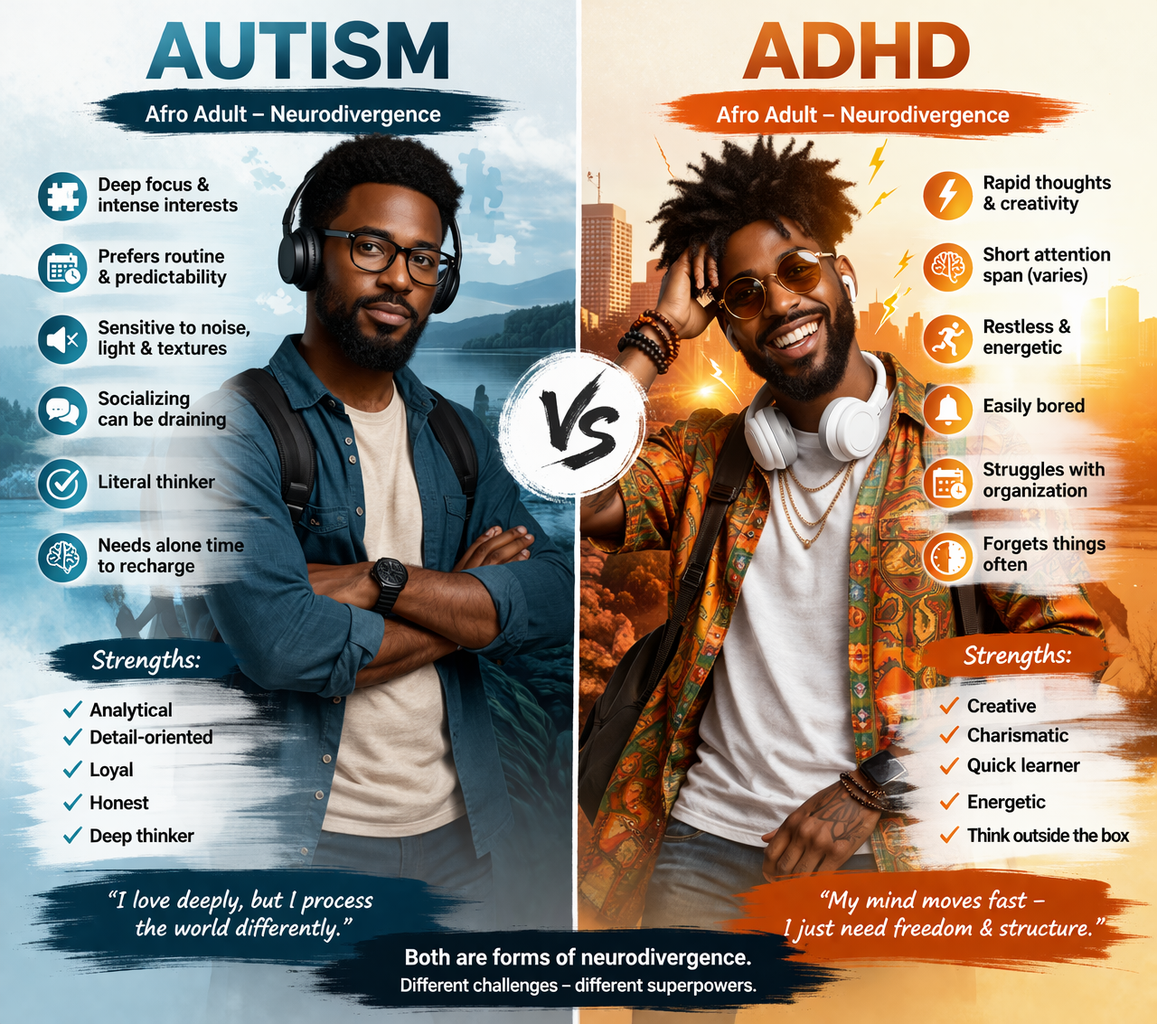
• affects communication and social interaction
• affects how a person understands and responds to the world
• often includes sensory differences
🔹 ADHD
• affects attention, focus and impulse control
• affects how a person manages tasks and behavior
• often involves difficulty with organization
👉 Both involve differences in how the brain functions, but they affect different systems.
3️⃣ Early symptoms
🔹 Autism
• limited eye contact
• difficulty with social interaction
• delayed or different communication
• repetitive behaviors
• strong preference for routine
🔹 ADHD
• difficulty focusing
• easily distracted
• impulsive behavior
• difficulty sitting still (in some cases)
• trouble completing tasks
4️⃣ Symptom explanation
Autism:
👉 the brain processes social and sensory information differently
👉 this affects communication and interaction
ADHD:
👉 the brain struggles to regulate attention and impulses
👉 this affects focus and behavior
5️⃣ Key differences
Social interaction
• Autism → difficulty understanding social cues
• ADHD → may understand but struggle with attention
Attention
• Autism → may focus deeply on specific interests
• ADHD → difficulty sustaining attention
Behavior
• Autism → repetitive behaviors, routines
• ADHD → impulsive, unpredictable behavior
Sensory sensitivity
• Autism → often present
• ADHD → less prominent
6️⃣ Overlap (important)
Autism and ADHD can share:
• difficulty with focus
• emotional regulation challenges
• social difficulties
👉 Some individuals may have both conditions.
7️⃣ When to seek help
🚨 Seek evaluation if:
• symptoms affect daily functioning
• difficulty with communication or attention
• challenges at school, work or relationships
👉 Early assessment helps guide support.
8️⃣ Management / support
🔹 Autism support
• structured routines
• communication support
• sensory-friendly environments
🔹 ADHD support
• organization strategies
• focus support
• behavioral strategies
👉 Professional guidance is important for both.
9️⃣ Diagnosis / evaluation
Diagnosis involves:
• detailed history
• behavioral patterns
• specialist assessment
👉 It is possible to have both conditions.
🔟 Important message
Autism and ADHD are different but can overlap.
Understanding the difference helps ensure the right kind of support.
🔹 FAQ
🔹 Can someone have both autism and ADHD?
Yes.
🔹 Which is more serious?
It depends on the individual.
🔹 Can adults have these conditions?
Yes.
🔹 Are they the same?
No, but they can overlap.
🔹 Should I seek help?
If symptoms affect daily life.
Related Health Topics
🔹 Autism Spectrum Disorder
🔹 ADHD in children
🔹 Emotional Regulation Difficulties
🔹 Anxiety – Symptoms
Medical References
• World Health Organization
• American Psychiatric Association
• Centers for Disease Control and Prevention
• National Health Service
• Mayo Clinic
• Peer-reviewed neurodevelopmental literature
Medical Disclaimer
This article is for educational purposes only and does not replace professional medical advice, diagnosis, or treatment.
If you have concerns, seek assessment from a qualified healthcare professional.