

🌍English
Published on March 12, 2026
🩺 Medically reviewed by Priscilla Afiakurue, MD, Family Medicine Physician | Founder & Lead Medical Editor · Last reviewed: July 2026
🔍 Quick Summary
Varicocele, hydrocele, and spermatocele are common causes of scrotal swelling.
They differ in cause, feel, and clinical significance.
1️⃣ Introduction
These three conditions all cause swelling in the scrotum—but they are not the same.
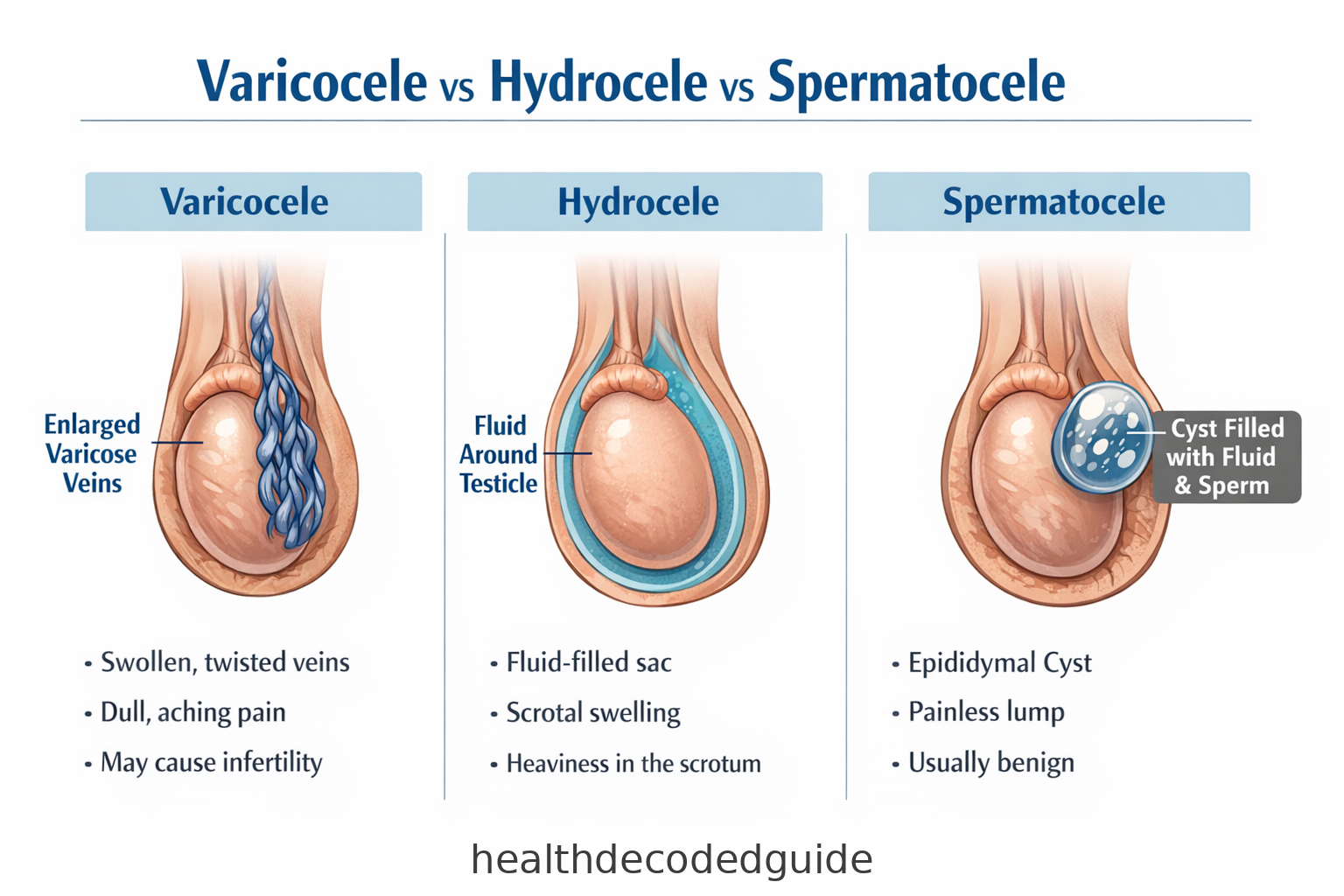
• varicocele = enlarged veins
• hydrocele = fluid around the testicle
• spermatocele = fluid-filled cyst near epididymis
👉 Understanding the differences helps reduce unnecessary worry.
2️⃣ How it happens
Each condition develops through a different mechanism.
• varicocele: faulty veins → blood pooling
• hydrocele: fluid accumulation around testicle
• spermatocele: blockage → cyst formation
👉 The cause determines how the swelling feels and behaves.
3️⃣ Types
• Varicocele
- vein-related swelling
- often left-sided
• Hydrocele
- fluid-filled sac
- smooth swelling
• Spermatocele
- cyst near epididymis
- separate from testicle
👉 Each has a distinct physical feel on examination.
4️⃣ Common causes
• Varicocele
- poor vein valve function
- increased pressure
• Hydrocele
- fluid imbalance
- inflammation or injury
• Spermatocele
- blockage in sperm ducts
- fluid build-up
5️⃣ Symptom explanation
• swelling in scrotum
• heaviness (more with varicocele or hydrocele)
• usually painless
👉 Symptoms depend on pressure, fluid, or vein enlargement.
6️⃣ Associated symptoms
• infertility (varicocele in some cases)
• smooth swelling (hydrocele)
• small painless lump (spermatocele)
• discomfort after standing
👉 Associated features help distinguish between them.
7️⃣ When it becomes dangerous 🚨
• rapid increase in size
• pain or tenderness
• hard lump inside testicle
👉 These may indicate:
• another condition (e.g. tumor)
• need for urgent evaluation
8️⃣ Management / treatment
• observation if no symptoms
• surgery if large or symptomatic
• fertility evaluation if needed (varicocele)
9️⃣ Diagnosis
• physical examination
• ultrasound of the scrotum
• clinical history
👉 Ultrasound confirms the type of swelling.
🟢Important message
Most scrotal swellings are harmless—but should be checked.
👉 Proper diagnosis provides reassurance and guides treatment.
Comparison between Varicocele Vs Hydrocele Vs Spermatocele
| Feature | Varicocele | Hydrocele | Spermatocele |
|---|---|---|---|
| Cause | Enlarged veins | Fluid around testicle | Cyst from epididymis |
| Feel | “Bag of worms” | Smooth, fluid-filled | Round, soft lump |
| Pain | Usually mild | Usually painless | Painless |
| Location | Around testicle | Surrounds testicle | Above/behind testicle |
| Common side | Left side | Either side | Either side |
| Fertility impact | Possible | Rare | Rare |
| Treatment | Monitor/surgery | Monitor/surgery | Usually none |
FAQ
• Which one is most serious?
Varicocele may affect fertility, but all are usually harmless.
• Do they need treatment?
Only if symptomatic or causing complications.
• Can they become cancer?
No. They do not turn into cancer, but any new testicular lump or swelling should be assessed by a healthcare professional.
• Can I still have children if I have a varicocele?
Yes. Many men with a varicocele have normal fertility, although some may have reduced sperm quality.
• How do doctors tell the difference?
A physical examination is often enough, but a scrotal ultrasound may be needed to confirm the diagnosis.
🔗 Related Health Topics
• Testicular lump
• Testicular pain
• Male Infertility
• Male Hormonal Imbalance
📚 Medical References
• National Health Service (NHS). Testicle lumps and swellings.
• Mayo Clinic. Scrotal masses – Symptoms and causes.
• Mayo Clinic. Varicocele – Symptoms and causes.
• Urology Care Foundation. Varicoceles: Symptoms, Diagnosis & Treatment.
• British Association of Urological Surgeons (BAUS). Testicular lump.
⚠️ Medical Disclaimer
This article is for educational purposes only and does not replace professional medical advice.
If you have symptoms or concerns, please consult a qualified healthcare professional.