🌍 Pidgin English
Published on September 20, 2026
🩺 Medically reviewed by the Health Decoded Guide Editorial Team · Last reviewed: September 2026
🔍 Quick Summary
Cardiac arrest happens when the heart suddenly stops pumping blood effectively. The person usually collapses, becomes unresponsive and stops breathing normally or only gasps. Without immediate CPR and an AED, the brain and other organs quickly lose their oxygen supply.
Cardiac arrest is a medical emergency — every minute matters.
🚨 Quick Action
If someone suddenly collapses, is unresponsive and is not breathing normally or is only gasping:
• Call your local emergency number and send someone to get an AED
• Start CPR immediately
• Use the AED as soon as it arrives
Do not waste time checking for a pulse if you are not a healthcare professional.
Treat an unresponsive person who is not breathing normally as cardiac arrest.
1️⃣ What is cardiac arrest?
Cardiac arrest means the heart suddenly stops producing effective circulation.
When this happens, blood stops reaching the brain and other vital organs. A person can lose consciousness within seconds, and brain injury can begin within minutes if circulation is not restored.
Cardiac arrest is not the same as a heart attack. A heart attack happens when blood flow to part of the heart muscle becomes blocked. A heart attack can sometimes trigger cardiac arrest, but they are different emergencies.
2️⃣ Why does cardiac arrest happen?
Normally, electrical signals coordinate each heartbeat so the heart pumps blood around the body.
During cardiac arrest, this electrical activity may become severely abnormal or stop producing an effective heartbeat. The heart can no longer pump enough blood to the brain and organs, causing sudden unconsciousness and abnormal or absent breathing.
Possible causes include:
• dangerous abnormal heart rhythms
• coronary artery disease or a heart attack
• heart muscle disease
• severe breathing problems or lack of oxygen
• drug poisoning or overdose
• drowning, electrocution or severe trauma
Sometimes the cause is not immediately known.
👉 Whatever the cause, the immediate problem is the same: circulation has stopped and CPR must begin quickly.
3️⃣ How do you recognise cardiac arrest?
The main signs are:
• sudden collapse
• unresponsiveness to touch or sound
• loss of consciousness
• no normal breathing or only gasping
Gasping can sometimes be mistaken for normal breathing.
👉 An occasional gasp does not mean the person is breathing normally.
4️⃣ What should you do?
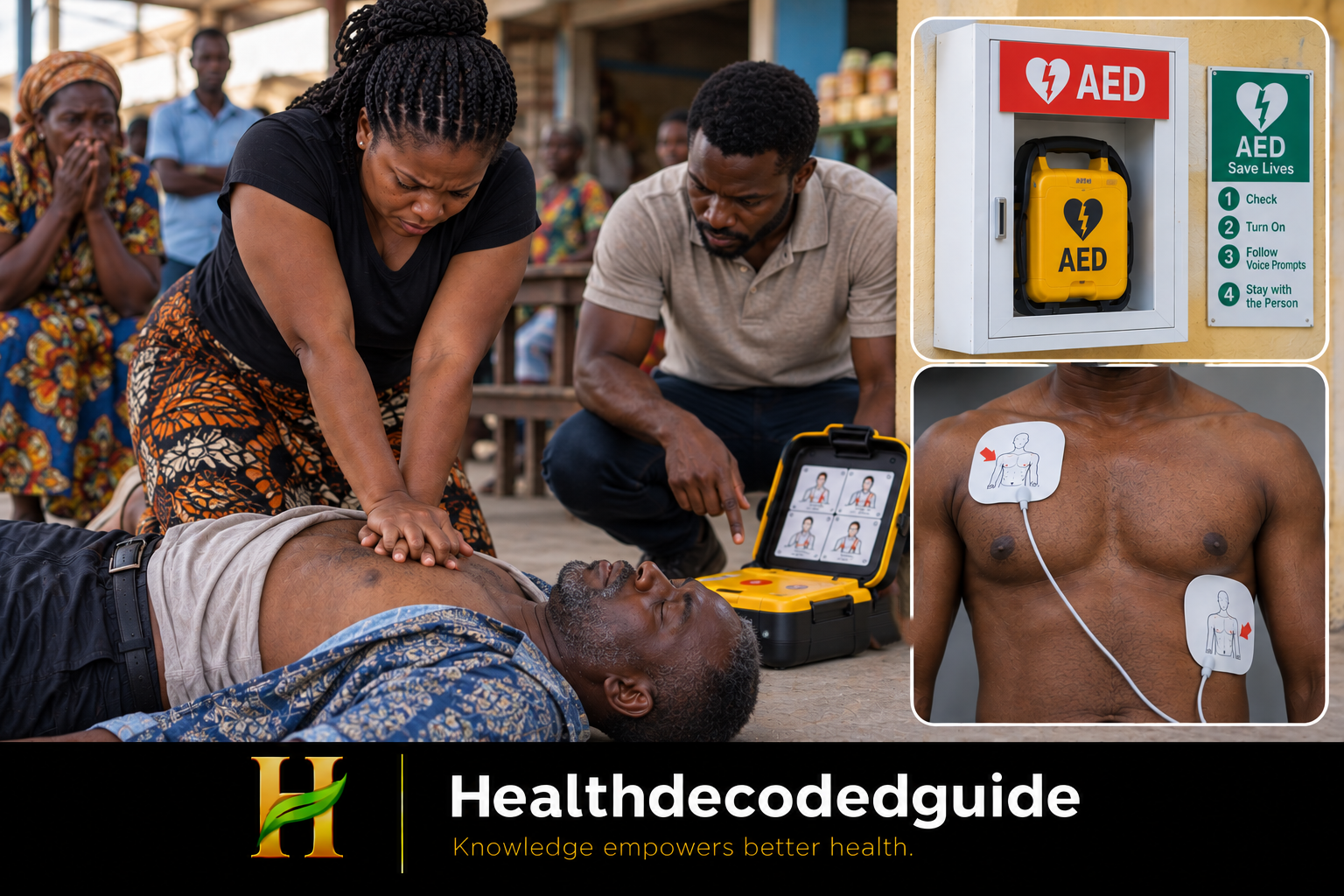
Call emergency services and start CPR.
For an adult, push hard and fast in the centre of the chest, allowing the chest to rise fully between compressions. Current AHA guidance recommends a compression rate of 100–120 per minute.
If an AED is available, switch it on, attach the pads and follow its instructions.
Continue CPR until:
• the person begins breathing or moving normally
• emergency professionals take over
• you are physically unable to continue
👉 Early CPR keeps some blood flowing to the brain and other organs while an AED may help restore a shockable heart rhythm.
5️⃣ What happens after cardiac arrest?
Someone whose heartbeat returns after cardiac arrest still needs urgent hospital treatment.
Doctors may investigate the cause and monitor the brain, heart, breathing and blood pressure. Further treatment depends on what caused the arrest and whether another dangerous heart rhythm is likely.
Possible complications include:
• brain injury from lack of oxygen
• heart damage
• kidney or other organ injury
• another cardiac arrest
🟢 Important Message
Cardiac arrest can happen suddenly and sometimes without warning.
Recognising collapse + unresponsiveness + abnormal or absent breathing and immediately starting CPR can make a major difference.
👉 Call for help → start CPR → use an AED as soon as possible.
FAQ
• Is cardiac arrest the same as a heart attack?
No. A heart attack involves blocked blood flow to the heart muscle; cardiac arrest means the heart has stopped pumping effectively.
• Can someone survive cardiac arrest?
Yes. Survival is more likely when CPR and defibrillation are started quickly.
• Should I check for a pulse before starting CPR?
Lay rescuers should not delay CPR to check for a pulse when someone is unresponsive and not breathing normally.
• Does gasping mean the person is breathing?
Not necessarily. Abnormal gasping can occur during cardiac arrest.
• Can an AED make things worse?
AEDs analyse the heart rhythm and only advise a shock when an appropriate shockable rhythm is detected.
🧠 Why We Delay
People may hesitate because they are unsure whether the person is truly in cardiac arrest or are frightened of performing CPR incorrectly.
That hesitation can cost valuable time.
👉 If someone suddenly collapses, does not respond and is not breathing normally, call emergency services and start CPR rather than waiting for certainty.
🔗 Related Health Topics
• AED Use
• CPR For Adults
• Heart Attack
• Fainting
• Choking First Aid for Adults
📚 Medical References
• American Heart Association — 2025 Adult Basic Life Support Guidelines
• American Heart Association — Treatment of Cardiac Arrest
• Heart & Stroke Foundation — Cardiac Arrest View resource
• American Heart Association — 2025 CPR and ECC Guidelines
⚠️ Medical Disclaimer
This article is for educational purposes only and does not replace professional medical advice.