🌍 English
Published on September 20, 2026
🩺 Medically reviewed by the Health Decoded Guide Editorial Team · Last reviewed: September 2026
🔍 Quick Summary
An automated external defibrillator (AED) is a device used when someone is in cardiac arrest — they suddenly collapse, do not respond and are not breathing normally.
The AED checks the heart rhythm and gives a shock only if one is needed. Call emergency services, start CPR and use the AED as soon as possible.
You do not need to be a healthcare professional to use an AED — switch it on and follow the voice instructions.
🚨 Quick Action
If someone suddenly collapses and is unresponsive and not breathing normally:
• Call emergency services and ask someone to get an AED
• Start CPR immediately
• Use the AED as soon as it arrives
Do not wait to see if the person improves — cardiac arrest needs immediate action.
1️⃣ What is an AED?
An AED is a portable device that checks the heart's electrical rhythm during cardiac arrest.
Some cardiac arrests are caused by dangerous abnormal rhythms that may respond to an electrical shock.
The AED automatically decides whether a shock is appropriate.
If no shock is needed, the machine will tell you to continue CPR.
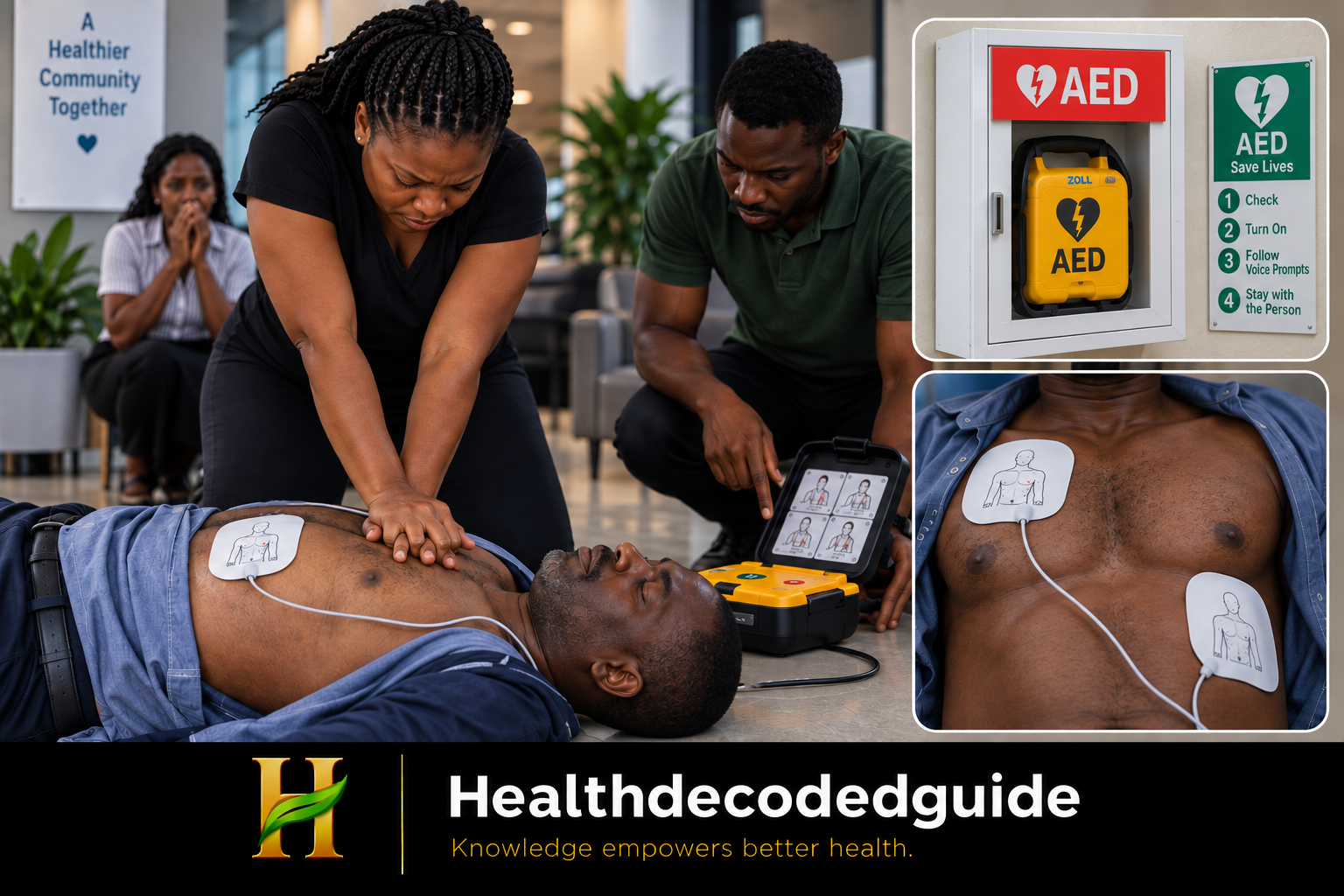
2️⃣ How do you use an AED?
Once the AED arrives:
• Turn it on and listen to the instructions
• Expose the chest and dry it if necessary
• Attach the pads exactly as shown in the pictures on them
• Make sure nobody is touching the person while the AED checks the rhythm
• If told to shock, make sure everyone is clear and press the shock button if required
• Restart CPR immediately after the shock — or if the AED says no shock is advised
Continue following the AED prompts until emergency services take over or the person begins showing clear signs of life.
You do not need to decide whether a shock is needed.
The AED checks the person’s heart rhythm and will only advise a shock when it detects a rhythm that may respond to one.
If it says “no shock advised,” continue CPR and follow the AED instructions.
3️⃣ Where do the AED pads go?
For most adults:
• one pad goes on the upper right side of the bare chest
• the second goes on the lower left side of the chest, below the armpit
Follow the picture printed directly on the pads.
If the pads may touch, such as in a small child, one may be placed on the chest and the other on the back.
4️⃣ What should you avoid?
Do not:
• delay CPR while searching for an AED
• place pads over wet skin — quickly dry the chest first
• touch the person while the AED is analysing or delivering a shock
• stop CPR for longer than the AED instructs
❗If a medicine patch is directly where a pad should go, remove the patch and wipe the area before applying the pad.
👉 The priority is speed — do not let minor concerns delay CPR or AED use.
5️⃣ Can you use an AED on a child?
Yes.
If paediatric pads or a child setting are available, use them for young children according to the device instructions.
If suitable paediatric equipment is not available and the child is in cardiac arrest, use the available AED rather than delaying defibrillation.
🟢 Important Message
Cardiac arrest can happen suddenly and the person's chance of survival falls rapidly without help.
Call for help, start CPR and use an AED as soon as one is available.
👉 The AED guides you step by step — acting quickly is more important than feeling perfectly confident.
FAQ
• Can anyone use an AED?
Yes. AEDs are designed so members of the public can follow the voice and visual instructions.
• Can an AED shock someone who does not need it?
The AED analyses the heart rhythm and only advises a shock when it detects an appropriate rhythm.
• Should I stop CPR when the AED arrives?
Only pause when the AED tells you to, such as during rhythm analysis or shock delivery.
• Can I use an AED if the person's chest is wet?
Yes, but quickly dry the chest before attaching the pads.
• Do I remove the pads after a shock?
No. Leave them attached and continue following the AED instructions.
🧠 Why We Delay
People often hesitate because they are afraid of using the AED incorrectly or causing harm.
But during cardiac arrest, doing nothing is far more dangerous than following the AED's instructions.
👉 Turn it on, listen carefully and act — the device is designed to guide you.
🔗 Related Health Topics
• Cardiac Arrest
• CPR for Adults
• CPR for Children
• Heart Attack
• Fainting
• Choking First Aid for Adults
📚 Medical References
• Heart & Stroke Foundation — AEDs
• American Heart Association — What Is an AED? How to Use One During a Cardiac Arrest
• American Red Cross — AED Steps
• Heart & Stroke Foundation — Cardiac Arrest
● British Heart Foundation (BHF). CPR and defibrillators: how to save a life.
⚠️ Medical Disclaimer
This article is for educational purposes only and does not replace professional medical advice.