Benign vs Malignant Tumour | Which One Be Cancer?
Pidgin English
Published on August 9, 2026 at 12:45 AM
🩺 Medically reviewed by the Health Decoded Guide Editorial Team · Last reviewed: August 2026
🔍 Quick Breakdown
When people hear d word “tumour,” plenty people immediately think say na cancer. But tumour and cancer no mean exactly d same thing.
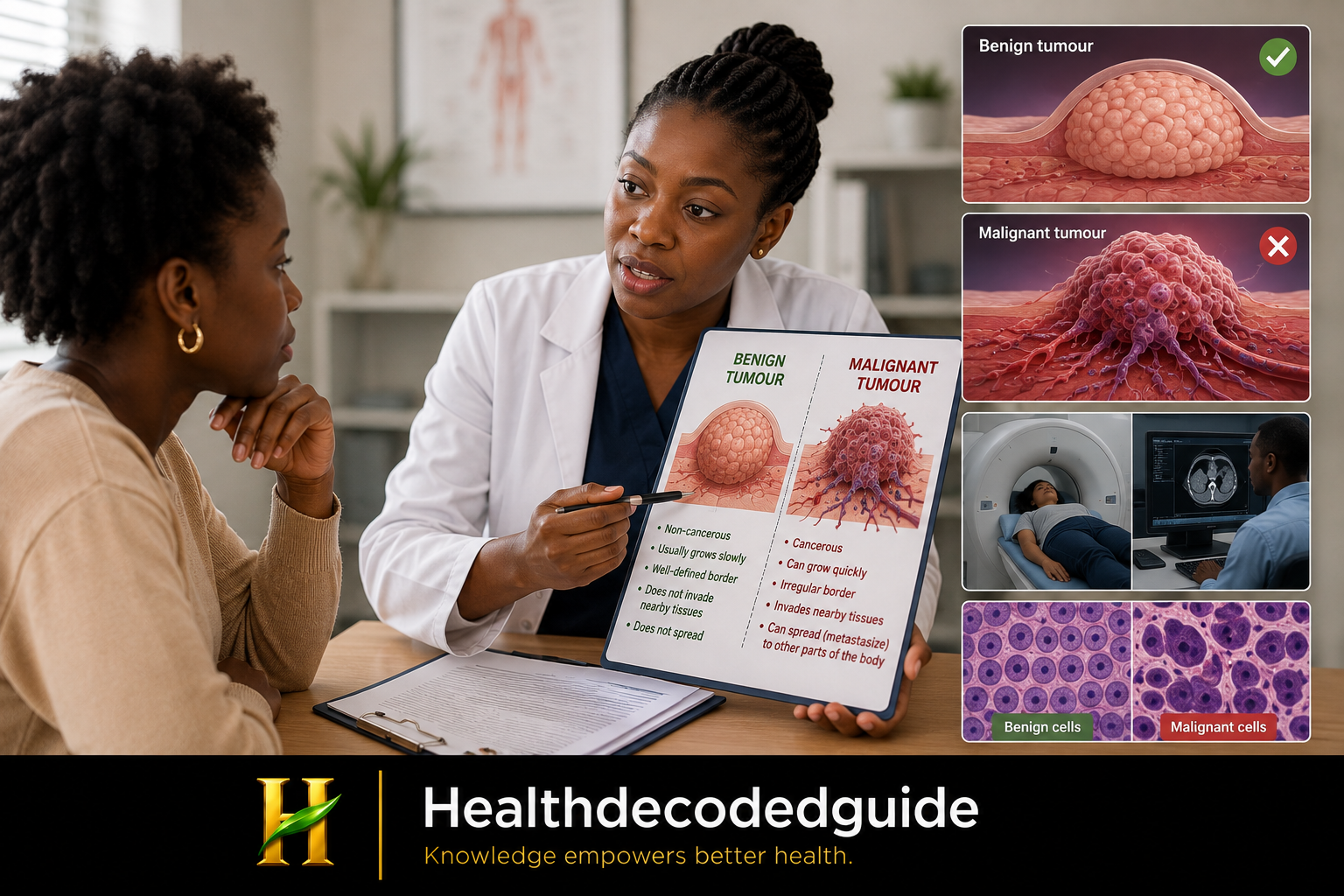
Tumour na abnormal growth of cells. E fit be benign (no be cancer) or malignant (na cancer).
To find one lump or tumour no automatically mean say person get cancer.
👉🏾Click here to sabi: wetin be cancer and how e dey develop.
🟧 Wetin be tumour sef?
Normally, your body dey control when d cells suppose grow, divide and wen e suppose stop to dey grow.
Sometimes, some cells fit begin dey grow more than dem suppose grow and dem gather together to form mass/lump wey doctors fit call tumour.
• some tumours dey grow slowly
• some fit remain for one place
• others fit enter surrounding tissues and spread
D important question no just be whether tumour dey—but na how d cells inside am dey behave.
🟧 So wetin be benign tumour?
Benign tumour no be cancer.
Usually:
• e dey grow slowly
• e dey remain around where e start
• e no invade nearby tissues like cancer
• e no spread to distant organs
Some benign tumours no even need treatment if dem no dey cause any problem.
👉🏾 “Benign” generally mean non-cancerous, but e no always mean say doctors fit completely ignore am.
🟧 How malignant tumour take different?
Malignant tumour na cancer.
D abnormal cells fit:
• continue to multiply
• enter nearby healthy tissues
• damage surrounding structures
• enter blood or lymph vessels
• eventually spread go reach another part of d body
When d cancer spread from where e start go reach another part of d body, doctors dey call am metastasis.
🟧 How you go know which one be which one?
You no fit sabi 100% whether one lump or swelling na benign or malignant cancer just by touching am.
Both fit sometimes:
• appear as lump
• grow gradually
• cause pain or pressure
• cause no symptoms at all
Even painless lump still deserve proper assessment if e new or e dey change.
No use pain alone judge lump. Painless no automatically mean harmless, and painful no automatically mean cancer.
🟧 Wetin you fit do
If you discover new lump:
• no squeeze or continuously to dey press am
• notice whether e dey grow or how e dey change
• pay attention to other unusual symptoms
• arrange medical assessment if e no go or e begin dey disturb you
• complete any test healthcare professional wey them recommend
Instead of guessing whether d lump na cancer, proper medical check fit give you d answer you actually need.
🟧 Real life example
Amaka notice small lump for her neck while she dey apply cream.
D lump no pain her.
At first:
• she fear say na cancer
• later she convince herself say because e no pain, e no fit serious
After some weeks, the lump still dey there, so she decide to visit clinic.
Doctor examine am and arrange d appropriate tests. D result show say d lump no be cancer.
After she understand, she decide to:
• follow d doctor's monitoring advice
• go do check up wen she notice say e change
Proper assessment give Amaka reassurance wey guessing no fit give her.
👉🏾 New lump no automatically mean cancer—but na medical assessment fit help determine wetin e really be.
🟧 🩺 When you suppose go hospital 🚨
• new lump wey no dey go or disappear
• lump dey grow or dey change
• lump wey dey hard or no dey move
• bleeding wey u no know wetin dey cause am
• unexplained weight loss
• persistent problem with how nearby body part dey work
👉🏾 These signs no automatically mean cancer, but early medical assessment important.
🟢 Final Reassurance
Plenty lumps and tumours no be cancer.
Even benign tumour fit sometimes need monitoring or treatment depending on d size and where e dey,
while malignant tumour need proper cancer care.
👉🏾 No panic because you find lump—but no ignore am either. To go check am na d best way to know wetin dey happen.
📚 Reference
For full medical references, see the English version of this article.
⚠️ Disclaimer
This article na for education only. E no replace doctor advice.
If you notice new or changing lump, unexplained symptoms or abnormal test result, abeg see healthcare professional.
🔗 Related Health Topics
• Wetin Be Cancer?
• How Cancer Dey Develop
• Wetin Dey Cause Cancer?
• How Cancer Dey Spread
• Cancer Warning Signs (coming soon)
👉🏾 If you still get questions or prefer full medical detail, read the English version.