English
🩺 Medically reviewed by the Health Decoded Guide Editorial Team · Last reviewed: July 2026
🟦 1. Quick Summary
Malaria and typhoid fever are two common infections in many tropical countries.
Because both illnesses can cause symptoms such as fever, headache and fatigue, they are often confused.
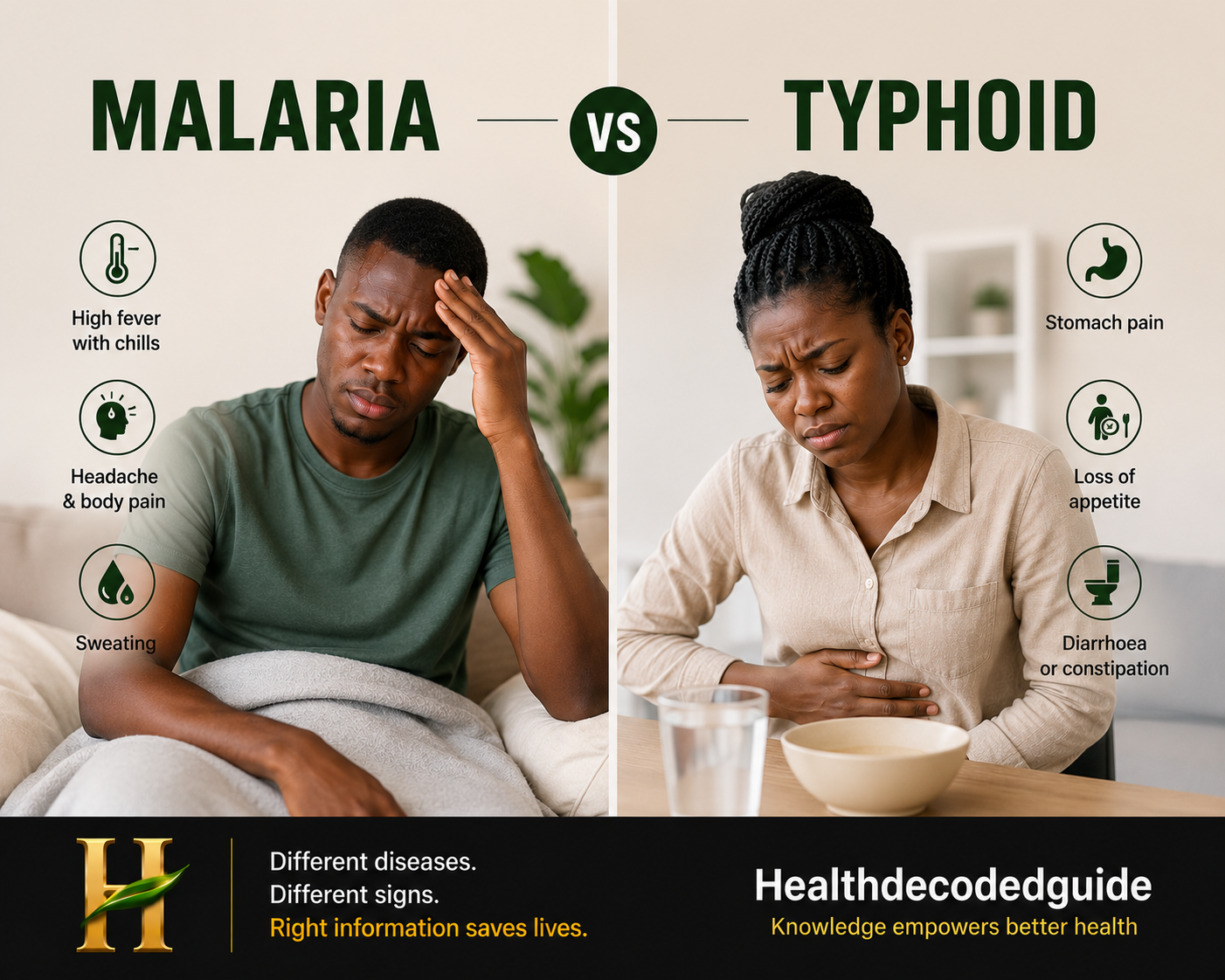
However, malaria and typhoid fever are caused by different organisms, spread in different ways and require different treatments.
Although some symptoms overlap, there are important differences that can help healthcare professionals identify the correct diagnosis.
If you have a persistent high fever or feel seriously unwell, seek medical care promptly. Early diagnosis and treatment help prevent complications.
| Feature | Malaria | Typhoid Fever |
|---|---|---|
| Cause | Parasite (Plasmodium species) | Bacteria (Salmonella Typhi) |
| How it spreads | Bite from an infected Anopheles mosquito | Contaminated food or drinking water |
| How symptoms begin | Usually sudden | Usually gradual |
| Fever | Often high with chills and sweating | Persistent fever that gradually rises |
| Headache | Common | Common |
| Fatigue or weakness | Common | Common |
| Body aches | Common | May occur |
| Abdominal pain | Less common | Common |
| Diarrhoea or constipation | Less common | Common |
| Loss of appetite | May occur | Very common |
| Skin rash | Rare | Rose-coloured spots may occur in some people |
| Main treatment | Antimalarial medicines | Antibiotics |
🟦 3. What Is Malaria?
Malaria is an infection caused by Plasmodium parasites, which are transmitted through the bite of infected female Anopheles mosquitoes.
Once inside the body, the parasites infect red blood cells, causing fever and other symptoms.
Common symptoms include:
Without prompt treatment, malaria can become severe and life-threatening.
🟦 4. What Is Typhoid Fever?
Typhoid fever is a bacterial infection caused by Salmonella Typhi.
It spreads through contaminated food or drinking water and is more common in areas with poor sanitation or limited access to clean water.
Common symptoms include:
-
Persistent fever
-
Headache
-
Loss of appetite
-
Weakness
In some people, small rose-coloured spots may appear on the chest or abdomen.
Without treatment, typhoid fever can lead to serious complications.
🟦 5. Why Are They Often Confused?
Malaria and typhoid fever share many early symptoms, including:
In many tropical countries, malaria is often the first illness people think about when someone develops a fever.
However, typhoid fever, dengue, influenza, COVID-19 and many other infections can also cause similar symptoms.
Because these illnesses overlap, it is not possible to diagnose malaria or typhoid based on symptoms alone. Laboratory testing is usually needed to identify the cause.
🟦 6. How Do Doctors Tell the Difference?
Healthcare providers begin by asking about your symptoms, recent travel, possible exposure to mosquitoes, food and water history, and medical history.
Tests may include:
For malaria:
-
Malaria rapid diagnostic test (RDT)
-
Blood smear microscopy
For typhoid fever:
-
Blood culture (the preferred test during early illness)
-
Stool or urine culture in selected situations
These investigations help confirm the diagnosis and ensure the correct treatment is started.
🟦 7. Can You Have Both Malaria and Typhoid Fever?
Yes.
Although uncommon, it is possible for someone to have malaria and typhoid fever at the same time, particularly in regions where both diseases are common.
Because of this possibility, healthcare professionals rely on laboratory tests rather than symptoms alone when making a diagnosis.
🟦 8. When Should You Seek Medical Care?
Seek medical care promptly if you develop:
-
A persistent or high fever
-
Severe weakness
-
Repeated vomiting
-
Severe abdominal pain
-
Difficulty staying awake
Early diagnosis and treatment can help prevent serious complications.
🟦 9. Key Takeaway
Malaria and typhoid fever are different infections that can cause similar symptoms.
Malaria is caused by parasites transmitted through mosquito bites, while typhoid fever is caused by bacteria spread through contaminated food or water.
Because the symptoms overlap, laboratory testing is usually needed to determine the correct diagnosis.
Prompt medical assessment ensures appropriate treatment and reduces the risk of complications.
🔗 Related Articles
📚 Medical References
-
World Health Organization. Malaria
https://www.who.int/news-room/fact-sheets/detail/malaria -
World Health Organization. Typhoid
https://www.who.int/news-room/fact-sheets/detail/typhoid -
Centers for Disease Control and Prevention (CDC). Malaria
https://www.cdc.gov/malaria/ -
Centers for Disease Control and Prevention (CDC). Typhoid Fever
https://www.cdc.gov/typhoid-fever/ -
CDC Yellow Book. Typhoid and Paratyphoid Fever
https://wwwnc.cdc.gov/travel/yellowbook/
⚠️ Medical Disclaimer
This article is for educational purposes only and is not a substitute for professional medical advice, diagnosis or treatment. Although every effort has been made to ensure the information is accurate and up to date, medical knowledge continues to evolve.
Always seek advice from a qualified healthcare professional if you have concerns about your health.