Read in: English | Pidgin English
🩺 Medically reviewed by the Health Decoded Guide Editorial Team · Last reviewed: July 2026
Quick Summary
Malaria and dengue are two mosquito-borne illnesses that are common in many tropical and subtropical regions.
Because both can cause fever, headache, muscle aches and fatigue, they are often confused with one another.
However, they are caused by different organisms, spread by different mosquitoes and require different treatments.
Recognising the differences can help people seek appropriate medical care and reduce the risk of serious complications.
| Feature | Malaria | Dengue |
|---|---|---|
| Cause | Parasite (Plasmodium) | Dengue virus |
| Spread by | Bite of an infected Anopheles mosquito | Bite of an infected Aedes mosquito |
| When the mosquito usually bites | Mainly from dusk to dawn (night-time) | Mostly during the day, especially early morning and late afternoon |
| How symptoms begin | Usually sudden | Usually sudden |
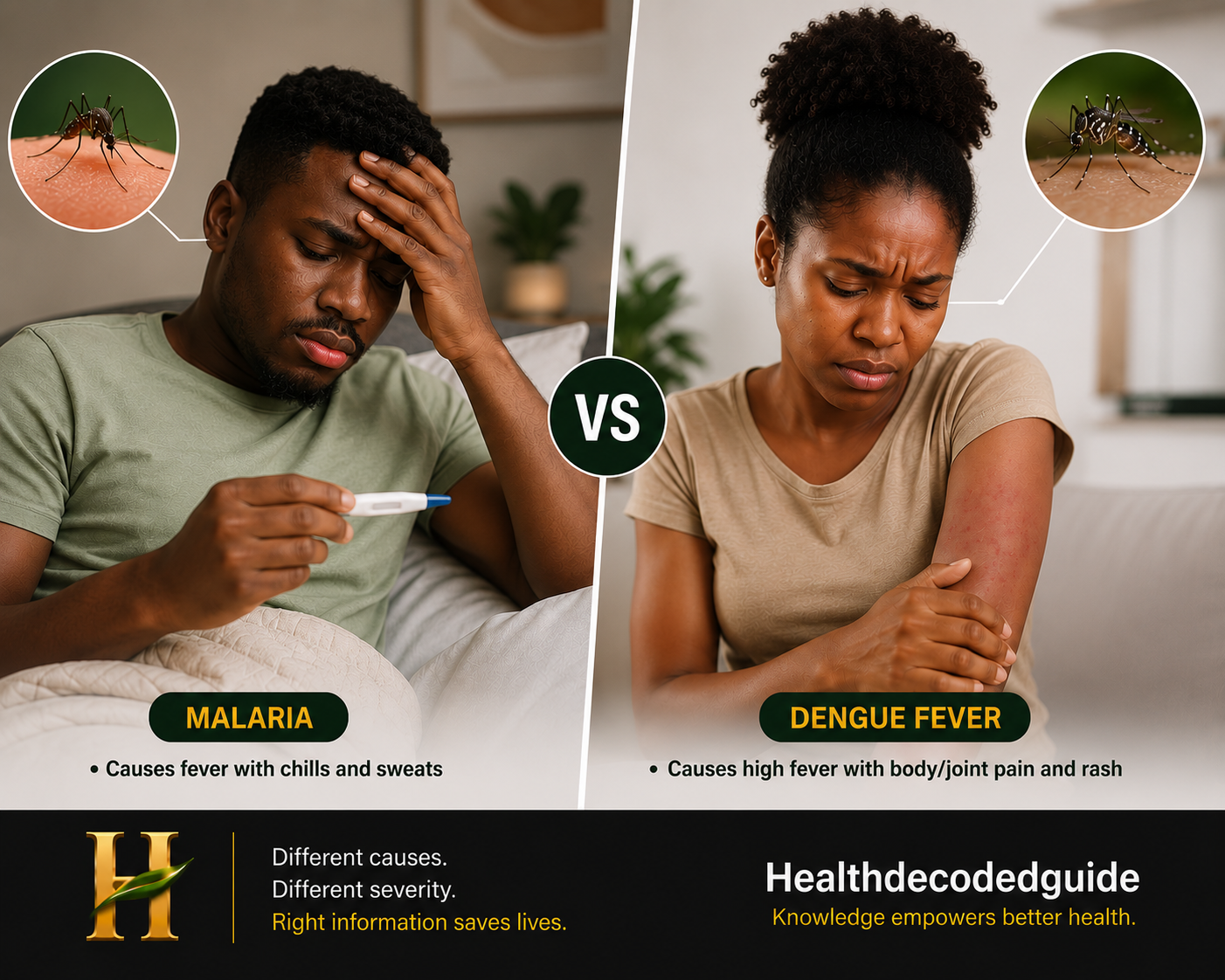
| Fever | High fever, often with chills and sweating | High fever, often without chills |
| Headache | Common | Very common, often severe |
| Muscle and joint pain | Common | Often severe ("breakbone fever") |
| Skin rash | Uncommon | Common |
| Bleeding (nose, gums or under the skin) | Rare | Can occur, especially in severe dengue |
| Main concern | Severe malaria affecting the brain or other organs | Severe dengue causing bleeding, shock or organ damage |
| Treatment | Antimalarial medicines | Supportive care (fluids, rest and careful monitoring) |
🟦 What Is Malaria?
Malaria is a parasitic infection caused by Plasmodium parasites.
It is transmitted through the bite of an infected Anopheles mosquito, which usually bites between dusk and dawn.
Once inside the body, the parasites infect red blood cells and can cause serious illness if not treated promptly.
Common symptoms include:
Without prompt treatment, malaria can lead to severe complications affecting the brain, kidneys and other organs.
🟦 What Is Dengue?
Dengue is a viral infection caused by the dengue virus.
It spreads through the bite of infected Aedes mosquitoes, which are most active during the day.
Many people recover within one to two weeks, but some develop severe dengue, which can become life-threatening.
Common symptoms include:
- Sudden high fever
- Severe headache
- Pain behind the eyes
- Muscle and joint pain
- Skin rash
- Nausea or vomiting
🟦 Why Are They Often Confused?
Malaria and dengue share several symptoms, including:
Because of these similarities, it is often impossible to tell the difference based on symptoms alone.
However, dengue is more likely to cause a skin rash, pain behind the eyes and bleeding in severe cases, while malaria commonly causes chills, sweating and can progress rapidly if left untreated.
🟦 How Do Doctors Tell the Difference?
Healthcare providers consider:
- Your symptoms
- Recent travel
- Whether you have been in an area where malaria or dengue is common
- Possible mosquito exposure
Laboratory tests are usually needed to confirm the diagnosis.
These may include:
For malaria
- Rapid malaria test (RDT)
- Blood smear microscopy
For dengue
- NS1 antigen test (early infection)
- Dengue PCR (in selected cases)
- Dengue IgM or IgG antibody tests
🟦 Can You Have Both at the Same Time?
Yes.
Although uncommon, a person can be infected with both malaria and dengue at the same time, particularly in areas where both diseases are common.
Because treatment differs, healthcare providers may test for both infections when symptoms suggest either condition.
🟦 When Should You See a Doctor?
Seek medical attention immediately if you develop:
- A high or persistent fever
- Difficulty breathing
- Confusion
- Persistent vomiting
- Severe abdominal pain
- Bleeding from the nose or gums
- Blood in vomit or stool
- Extreme weakness or dizziness
- Difficulty staying awake
Prompt diagnosis and treatment can reduce the risk of serious complications.
🟦 Key Takeaway
Malaria and dengue are both mosquito-borne illnesses, but they are caused by different organisms and require different approaches to treatment.
Because their symptoms often overlap, laboratory testing is usually needed to confirm the diagnosis.
If you develop a fever after mosquito exposure or travel to a malaria- or dengue-prone area, seek medical care promptly rather than trying to diagnose yourself.
🔗 Related Articles
- Malaria
- Dengue Fever
- Fever in Adults
- Mosquito Bite Prevention (coming soon)
- Malaria vs Typhoid
- Cholera vs Gastroenteritis
📚 Medical References
• World Health Organization (WHO) – Malaria: https://www.who.int/teams/global-malaria-programme
• World Health Organization (WHO) – Dengue and severe dengue: https://www.who.int/news-room/fact-sheets/detail/dengue-and-severe-dengue
• Centers for Disease Control and Prevention (CDC) – Malaria: https://www.cdc.gov/malaria/
• Centers for Disease Control and Prevention (CDC) – Dengue: https://www.cdc.gov/dengue/
• NHS (National Health Service, UK) – Dengue: https://www.nhs.uk/conditions/dengue/
⚠️ Medical Disclaimer
This article is for educational purposes only and is not a substitute for professional medical advice, diagnosis or treatment. Although every effort has been made to ensure the information is accurate and up to date, medical knowledge continues to evolve.
Always seek advice from a qualified healthcare professional if you have concerns about your health or develop severe or persistent symptoms.