

Read in: English | Pidgin English
🩺 Medically reviewed by theHealth Decoded Guide Editorial Team· Last reviewed: July 2026
🔎 Quick Summary
Cholera and typhoid fever are both bacterial infections that can spread through contaminated food or water, but they affect the body in different ways.
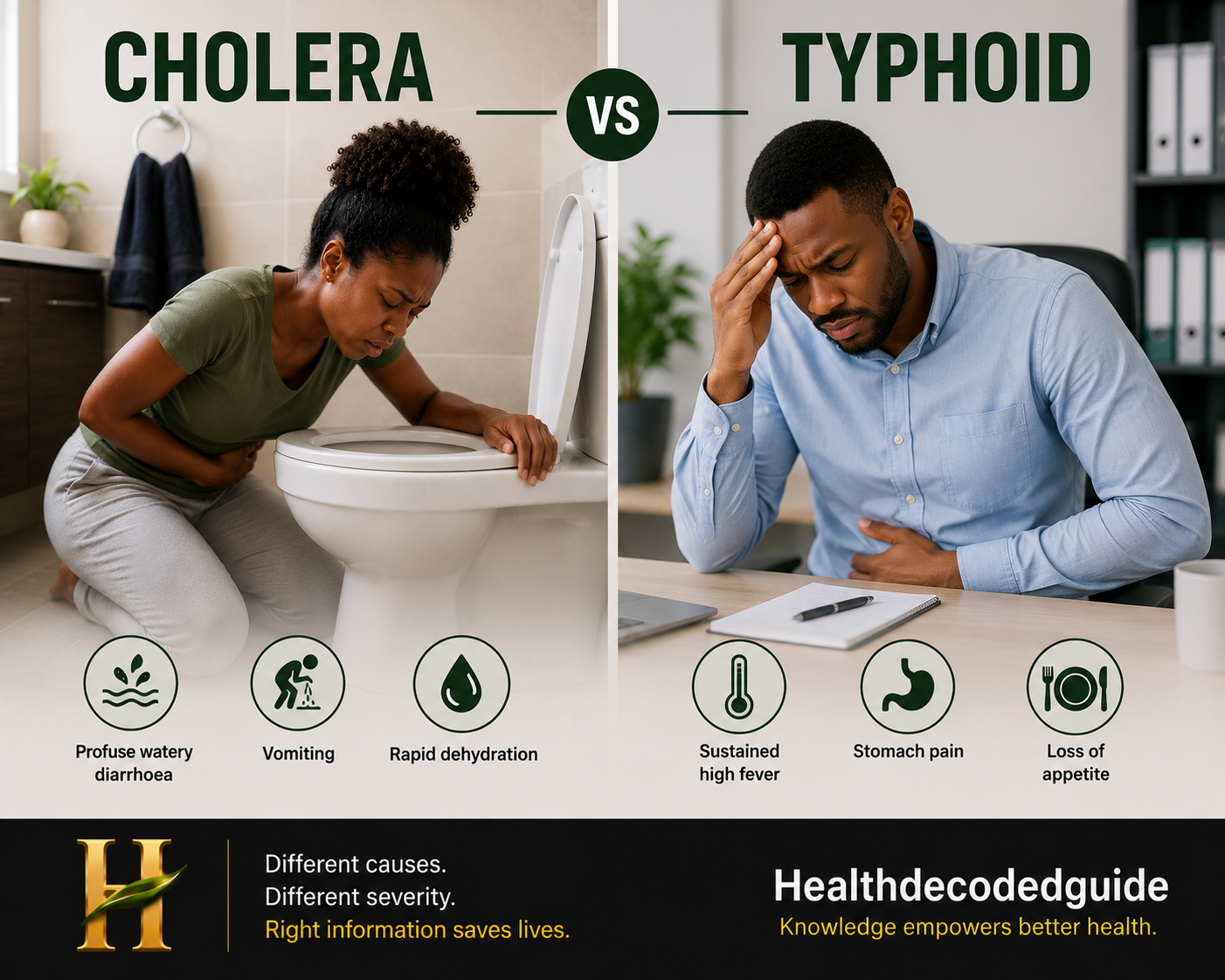
Cholera usually causes sudden, severe watery diarrhoea and rapid dehydration, while typhoid fever more often causes persistent fever, abdominal pain and gradually worsening illness.
Laboratory tests are often needed to confirm the diagnosis.
| Feature | Cholera | Typhoid Fever |
|---|---|---|
| Cause | Vibrio cholerae bacteria | Salmonella Typhi bacteria |
| How it spreads | Contaminated food or drinking water | Contaminated food or drinking water |
| How symptoms begin | Usually sudden | Usually gradual |
| Main symptom | Profuse watery diarrhoea | Persistent fever |
| Dehydration | Very common | Less common |
| Abdominal pain | Usually mild or absent | Common |
| Main treatment | Rehydration ± antibiotics | Antibiotics |
🟦What causes each disease
Cholera is caused by Vibrio cholerae bacteria, usually spread through contaminated drinking water.
Typhoid fever is caused by Salmonella typhi bacteria, which spreads through contaminated food or water.
Both diseases are more common where sanitation and clean water are limited.
🟦Symptoms comparison
Cholera symptoms
• sudden watery diarrhea
• vomiting
• intense thirst
• dehydration
• weakness
Typhoid symptoms
• persistent fever
• headache
• abdominal Pain
• fatigue
• constipation or diarrhea
🟦Why Are They Often Confused?
- both spread through poor sanitation
- both can cause diarrhoea
- both can cause weakness
- but cholera is mainly a dehydration illness while typhoid is a systemic bacterial infection
👉 Co-infection is also possible. In regions where sanitation and water safety are limited,
it is possible—though not common—for a person to be infected with both cholera and typhoid fever at the same time.
This is one more reason laboratory testing, rather than symptoms alone, is the most reliable way to confirm a diagnosis.
🟦 When to seek medical care
Seek medical care urgently if someone has:
- Severe watery diarrhea
- Persistent high fever
- Very little or no urine
- Extreme thirst
- Sunken eyes
- Confusion
- Unable to drink fluids
- Severe weakness
Early treatment greatly improves recovery.
🟦 How Do Doctors Tell the Difference?🩺
Doctors may ask about recent travel, food and water exposure, and symptoms.
Tests may include:
- Stool testing for cholera
- Blood culture for typhoid fever
- Stool culture in selected cases
🔗 Related Health Topics
• Cholera
• Dengue fever
• Food Poisoning
• Typhoid Fever
• Diarrhea
• Dehydration
📚 Medical References
• World Health Organization (WHO) – Cholera:https://www.who.int/news-room/fact-sheets/detail/cholera
• World Health Organization (WHO) – Typhoid:https://www.who.int/news-room/fact-sheets/detail/typhoid
• Centers for Disease Control and Prevention (CDC) – Cholera:https://www.cdc.gov/cholera/
• Centers for Disease Control and Prevention (CDC) – Typhoid Fever:https://www.cdc.gov/typhoid-fever/
• CDC Yellow Book – Cholera: https://www.cdc.gov/yellow-book/hcp/travel-associated-infections-diseases/cholera.html
• CDC Yellow Book – Typhoid and Paratyphoid Fever: https://www.cdc.gov/yellow-book/hcp/travel-associated-infections-diseases/typhoid-and-paratyphoid-fever.html
⚠️ Medical Disclaimer
This article is for educational purposes only and does not replace professional medical advice, diagnosis, or treatment. Always consult a qualified healthcare professional regarding medical concerns.